hardware
The 'Picks and Shovels' of Perception: Why Edge Vision is the Real Gold Mine of Physical AI
Luxonis's $14M Series A for its OAK edge-AI camera platform is a textbook picks-and-shovels play in the physical AI gold rush, because before any robot can act on the world, it first has to see it.
By Daniel Osei, Financial Analysis · June 29, 2026 · 10 min read
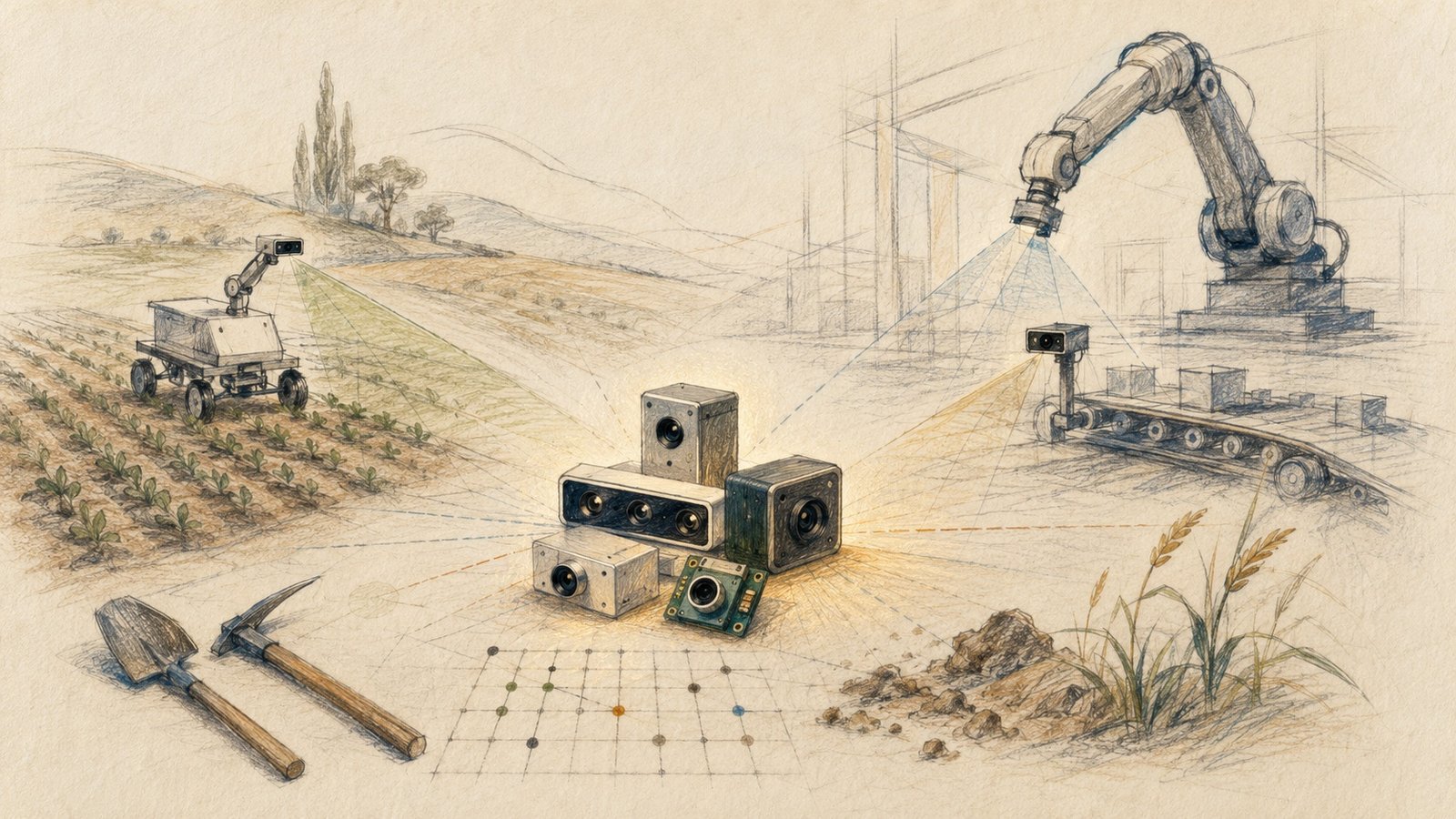
Close-up of a Luxonis OAK camera module with depth-sensing overlays and a dusty industrial field environment in the background
If you follow the mainstream tech press, you would be forgiven for thinking the future of robotics is entirely defined by two things: bipedal legs and massive, cloud-based foundation models. We are constantly inundated with polished videos of humanoid robots performing gymnastics, while executives tout the theoretical limits of centralized architectures like NVIDIA's Project GR00T.
But talk to any engineer actually trying to deploy a robot onto a dusty Iowa farm or a vibrating factory floor, and a very different reality emerges. The true bottleneck to scaling physical AI isn't the brain in the cloud or the motors in the legs; it is the raw, unsexy hardware that allows the machine to see its environment.
On July 2, this vital secondary market was validated when Denver-based edge AI vision company Luxonis closed a $14 million Series A, led by Denali Growth Partners and Taiwania Capital. The capital is earmarked to aggressively scale production of its OAK camera platform, a unified piece of hardware that combines stereo depth, high-resolution color, and powerful on-device AI compute. This funding round is a textbook "picks and shovels" play. During a gold rush, the most predictable wealth isn't generated by the miners hunting for the motherlode; it's generated by the merchants selling the tools. In the physical AI boom, perception hardware is the ultimate tool.
The Cloud Delusion in Physical Environments
To understand why a company building cameras just raised an eight-figure round in a tough macro environment, we have to dismantle the delusion of cloud-based robotics.
In the software world, it makes perfect sense to offload heavy compute to a server rack in Virginia. But a combine harvester operating in a rural agricultural zone does not have reliable 5G. A warehouse sorting facility is essentially a giant Faraday cage where Wi-Fi signals go to die. If an autonomous tractor relies on the cloud to decide whether a visual anomaly is a shadow, a weed, or a human worker, a half-second drop in connectivity isn't just an error, it is a catastrophic safety hazard.
This is where "edge AI" becomes a non-negotiable requirement. Systems like the Luxonis OAK 4 series bypass the cloud entirely by packing up to 52 TOPS (Tera Operations Per Second) of AI compute directly onto the camera module itself. The neural network inference, counting grain loss, detecting crop diseases, or identifying a forklift's trajectory, happens locally, in real-time, right behind the lens.
Key insight: By processing visual data on-device, edge cameras don't just solve the latency problem; they solve the data avalanche. Sending raw 4K video feeds from a fleet of 50 robots to the cloud every second would bankrupt a facility in bandwidth costs alone. Edge vision only transmits the insights (e.g., "obstacle detected"), reducing data payloads by over 99%.
The Brutal Reality of Ruggedization
The second reason edge vision is a massive growth vector is the sheer hostility of the physical world. A foundational software model doesn't care if it gets wet. A server rack sits in a climate-controlled room. But a camera mounted to the header of a combine harvester has to survive brutal conditions.
The engineering challenge that companies like Luxonis are solving is not just algorithmic; it is deeply material. Their hardware must maintain precise stereo depth calibration while enduring constant, low-frequency chassis vibration. The enclosures must hold an IP67 rating, meaning they are completely sealed against the microscopic agricultural dust that destroys standard electronics, while surviving pressure washing at the end of a shift. They must operate in blistering heat and freezing cold without thermal throttling the onboard neural processors.
This level of ruggedization creates a massive moat. A Silicon Valley AI startup cannot simply pivot into building industrial-grade hardware in a few months. It requires deep expertise in optoelectronics, thermal management, and supply chain logistics, which is exactly why Luxonis leaned heavily into Taiwan's robust manufacturing ecosystem for its latest funding round.
The Invisible Infrastructure of Autonomy
While the broader public remains captivated by the race to build the perfect, generalized humanoid, the actual industrial automation revolution is happening right now, quietly powered by these modular perception units.
An agricultural startup doesn't need to reinvent computer vision to build a smart weeding robot; they can simply bolt an OAK camera onto their chassis, plug in a Power-over-Ethernet (PoE) cable, and instantly give their machine human-level spatial awareness. By commoditizing the perception layer, edge vision providers are massively accelerating the time-to-market for the entire robotics industry.
The $14 million Series A is a clear signal: the foundational models are built, the algorithms are capable, and the market is demanding deployment. The real winners of the next five years won't necessarily be the companies building the flashiest robots, but the ones providing the unsexy, indestructible hardware that allows those robots to actually see the world they are meant to change.
More From Robotics Weekly




Part of Issue 3: The Accountability Gap, published June 29, 2026→