physical-ai
The Hardware War is Over. The Data Engine Era Begins.
Apptronik's pairing of the Apollo 2 humanoid with a dedicated data collection facility signals the industry's real competition has shifted from building better hardware to feeding better training pipelines.
By Maya Chen, Humanoid Robotics · July 6, 2026 · 10 min read

The Apptronik Apollo 2 humanoid robot operating inside a large data collection facility with motion capture rigs
For the past five years, the robotics industry has been locked in a race of mechanical pageantry. We have watched companies trade blows over joint torque, payload-to-weight ratios, and the aesthetic elegance of bionic hands. But Apptronik’s dual launch last week, pairing the Apollo 2 humanoid with a massive, dedicated data collection facility, signals that this phase of the industry is effectively over.
The physical chassis is rapidly becoming commoditized. The actual battleground has shifted entirely to the data engine. The industry is finally acknowledging a hard truth: a physical AI system is only as capable as the pipeline that feeds it.
The Commoditization of the Chassis
To understand why Apollo 2’s data facility is the real story, we have to look at the state of hardware manufacturing. High-performance actuators, harmonic drives, and tactile sensors are no longer bespoke, closely guarded secrets, they are accessible supply chain components. Just as the smartphone wars eventually ceased to be about the glass and the aluminum, the humanoid race is moving past the servos and the steel.
When anyone with sufficient capital can assemble a robot that walks, balances, and grasps, hardware ceases to be a defensive moat. What cannot be easily bought from a supplier, however, is physical intuition.
The VLA Data Famine: Physics Cannot Be Scraped
The consensus among serious practitioners is that Vision-Language-Action (VLA) models represent the definitive architecture for generalized robotics. We have seen how tightly integrated architectures, like the X1-D model, demonstrate the immense potential of linking visual understanding and natural language reasoning directly to motor control.
However, building a VLA model exposes a massive, structural friction point that LLM developers never had to navigate: you cannot scrape the internet for physical interaction data.
Large Language Models thrive on the endless buffet of human text. But text and video lack proprioception. A YouTube video of a person folding a shirt does not record the micro-adjustments in grip strength, the torque feedback from the fabric, or the depth-mapped spatial coordinates required to execute the task. To train a VLA model, every single physical interaction must be perfectly synchronized across visual state, language intent, and joint-level action arrays.
Apptronik’s dedicated facility is a stark acknowledgment of this data famine. The bottleneck for scaling humanoids into dynamic industrial settings isn't mechanical engineering; it's the agonizingly slow process of generating high-fidelity, task-specific, multimodal data.
The Illusion of Sim-to-Real
Until now, many companies attempted to bypass this bottleneck using synthetic data generated in physics simulators. The theory was that a robot could run millions of iterations in the cloud and seamlessly transfer that knowledge to the factory floor.
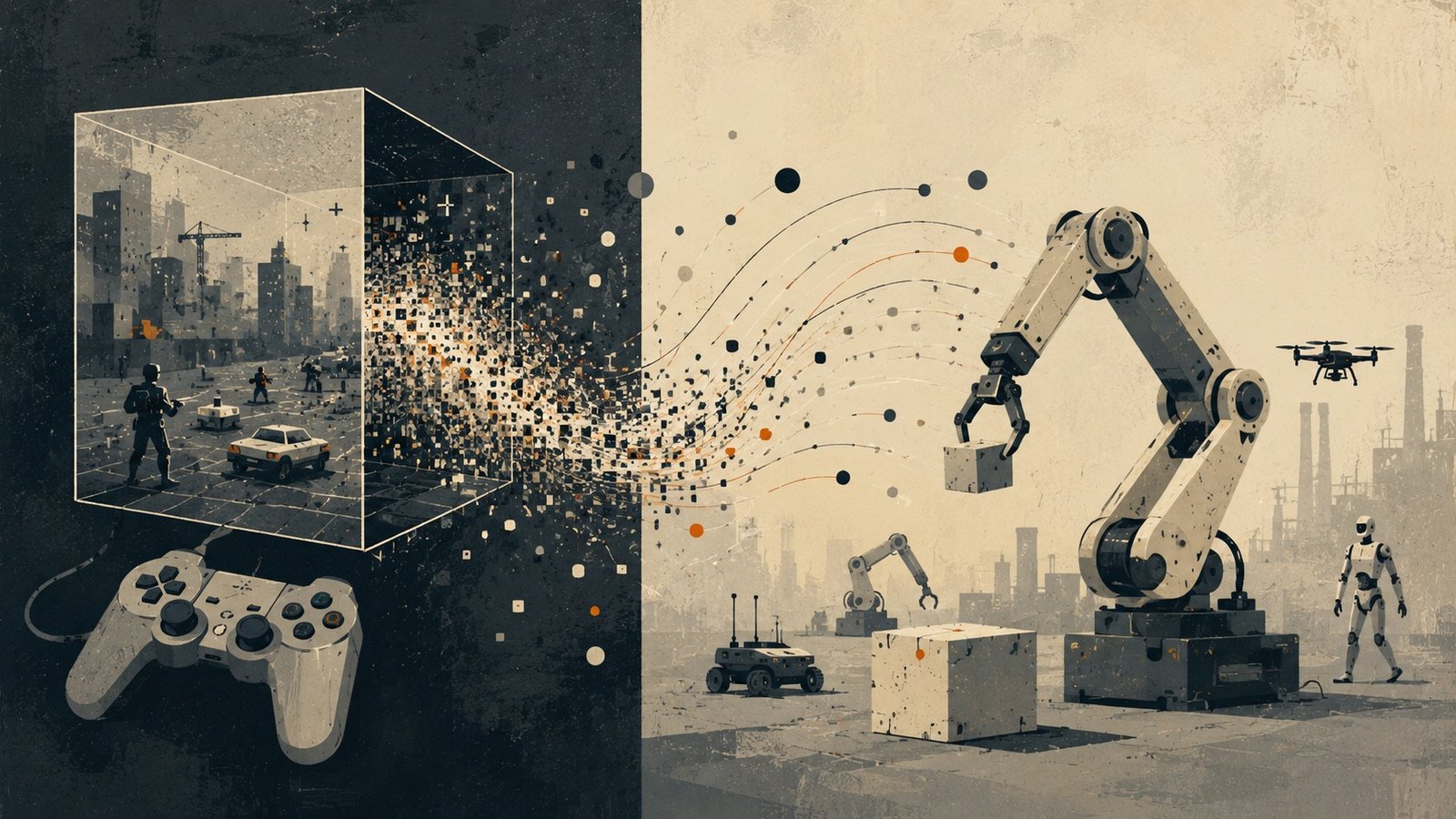
But simulation is an idealized abstraction. It cannot fully replicate the long-tail edge cases of reality, the subtle degradation of a tool's friction over months of use, the unpredictable glare of overhead lighting on a metallic surface, or the erratic movement patterns of human coworkers. Apptronik’s investment in a physical data engine proves that while sim-to-real is a useful primer, there is no substitute for grounded, real-world ingestion.
The new playbook requires human-in-the-loop teleoperation at an industrial scale. Human operators guide the robots through complex tasks, capturing perfectly aligned sensorimotor data. This data is fed into the foundation model, allowing it to generalize the policy. The robot then attempts the task autonomously, and when it fails or encounters an edge case, the system flags the interaction, captures the failure state, and feeds it back into the loop.
The Edge Compute Imperative: A First-Principles Approach
This closed-loop learning pipeline forces a radical rethinking of system architecture. Deploying a continuous-learning VLA model into a dynamic environment requires a first-principles approach to localized execution.
We are seeing a hard rejection of the bloated, cloud-dependent SaaS architectures that have plagued early smart-device deployments. When a 160-pound machine is manipulating heavy payloads around human workers, a 200-millisecond round-trip cloud latency is not an inconvenience, it is a critical failure. Physical interaction demands deterministic, ultra-low-latency execution.
The intelligence must live at the edge. Apollo 2 and its contemporaries must function as native, local-first systems. They process visual and tactile feedback entirely on-device, adapt their action logic in real-time without pinging a server, and only sync their refined weights or failure logs back to the central data engine during low-bandwidth off-peak cycles. The robot itself becomes a decentralized, autonomous data harvester, rather than a dumb terminal waiting for cloud instructions.
The Ingestion Pipeline is the Product
If you are evaluating the viability of robotics platforms in 2026, you must stop indexing purely on their degrees of freedom, their walking speed, or their battery capacity. Look strictly at the maturity of their data ingestion pipelines.
Apptronik’s dual launch is a masterclass in modern robotics strategy. They understand that the hardware is simply the vessel for capturing state and executing policy. The proprietary, continuous stream of edge-processed interaction data is the actual product. Over the next five years, the companies that dominate industrial automation won't necessarily be the ones that engineer the most elegant physical machines. They will be the ones that build the most ruthlessly efficient engines for converting raw physics into trainable tokens.
More From Robotics Weekly


Part of Issue 4: Who Owns the Stack, published July 6, 2026→