physical-ai
The Simulation Advantage: Why Gaming Data is the New Oil for Physical AI
General Intuition's $2.3B valuation is a bet that the solution to physical AI's training data famine isn't building more robots, but tapping into the richest repository of human decision-making that already exists: video games.
By Maya Chen, Humanoid Robotics · July 6, 2026 · 10 min read
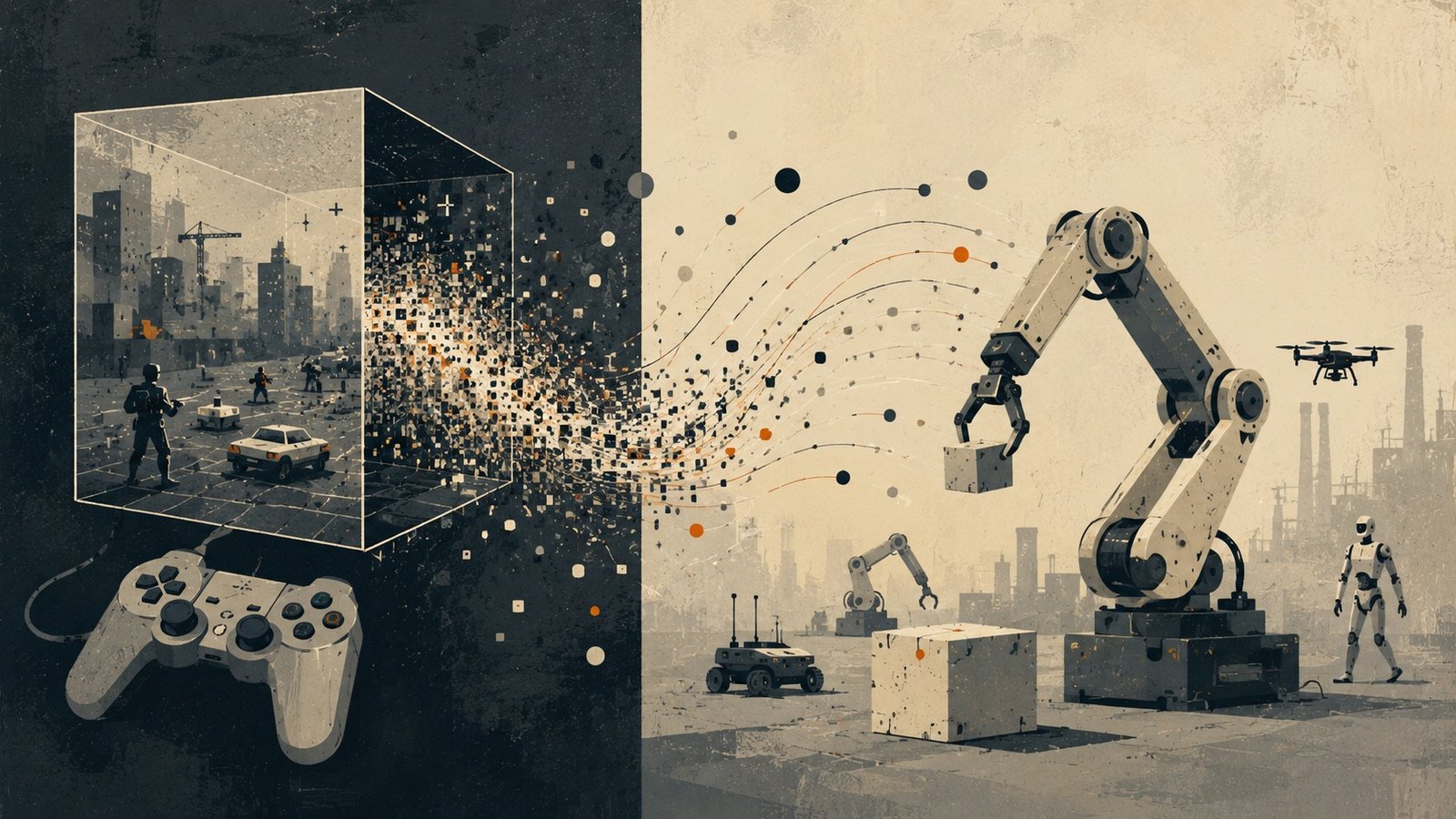
Split image showing a first-person video game environment on one side and a robot training simulation on the other, with shared data flow between them
General Intuition’s $320 million Series A round, vaulting the company to a $2.3 billion valuation, is not just another massive AI funding announcement. It represents a fundamental shift in how the industry thinks about training data. For years, the bottleneck for generalized robotics hasn't been the hardware; it has been the agonizing lack of high-fidelity, multimodal training data.
While LLMs gorged on the internet’s text, physical AI has starved. You cannot scrape the web for proprioception or spatial-temporal reasoning. General Intuition is betting that the solution isn't building millions of expensive robots to wander the physical world, but rather tapping into the largest existing repository of interactive human decision-making: video games.
The Limits of Passive Video
Until now, the default approach to visual training data has been passive observation. Companies scrape millions of hours of YouTube videos showing humans chopping onions, folding clothes, or navigating rooms.
The problem is that this data is functionally "flat." A video of a person driving a car shows you what the environment looked like, but it doesn't tell you how hard they pressed the brake pedal, the micro-adjustments they made to the steering wheel to compensate for a slip, or the causal relationship between their physical input and the resulting physics.
To train an agent that can act in the physical world, you need action-labeled data. You need the "why" and the "how," not just the "what."
The Democratization of Intent
This is where General Intuition’s dataset, derived from the gaming clip platform Medal, creates a massive, nearly insurmountable moat. Medal processes roughly 2 billion gameplay clips annually. But crucially, these aren't just passive videos; they are embedded with the exact ground-truth telemetry of the player.
When a player navigates a complex environment in a game like Fortnite, the system records the exact moment they pressed the jump button, the precise analog stick movement required to dodge an obstacle, and the immediate visual consequence of those actions within a physics engine. This provides the AI with perfect, labeled causality. It learns the relationship between perception (seeing a gap), intent (deciding to jump), and execution (pressing the button).
This is the holy grail for Vision-Language-Action (VLA) models. The gaming world offers an infinite, democratized supply of structured, interactive data generated by millions of humans solving complex spatial problems in real-time.
Transferring Gaming Logic to Physical Actuators
The skepticism surrounding this approach usually centers on the fidelity of physics. A skeptic will point out that jumping in a video game does not account for real-world gravity, friction, or the torque limits of a physical servo.
But this argument misses the point of foundation models. General Intuition isn't trying to teach a robot the literal mechanics of jumping over a digital wall. They are teaching the logic of navigation, spatial awareness, and dynamic problem-solving.
Once an AI model understands the general concepts of object permanence, pathfinding, and cause-and-effect from billions of hours of varied gaming environments, transferring that "intuition" to a physical chassis becomes a much smaller leap. In fact, General Intuition has already demonstrated that a model trained purely on gaming data can navigate a physical robot through an office after only eight minutes of real-world fine-tuning.
The Synthetic Training Ground
If the industry is rapidly exhausting the supply of high-quality internet text for LLMs, the robotics sector is already facing a physical data famine. By treating digital worlds as legitimate, high-volume synthetic training grounds, General Intuition is effectively bypassing the slow, expensive process of physical data collection.
They are proving that "gaming logic" isn't just an abstraction, it is the most scalable proxy we have for human physical intuition. The companies that master this translation from digital simulation to physical actuation will own the foundational layer of the next decade of robotics.
For more context on how world models and video game data intersect with robotics training, you can watch Ep#42: General Intuition. This video explores how gaming data teaches movement and spatial reasoning for embodied AI.
More From Robotics Weekly




Part of Issue 4: Who Owns the Stack, published July 6, 2026→