robotics-markets
The S-1 Reality Check: Wall Street Doesn't Care About Your Backflips
Agility Robotics' $2.5B SPAC deal forces the humanoid industry to confront public market discipline, where quarterly revenues matter more than choreographed demos and order backlogs must convert to actual cash.
By Daniel Osei, Financial Analysis · July 6, 2026 · 8 min read

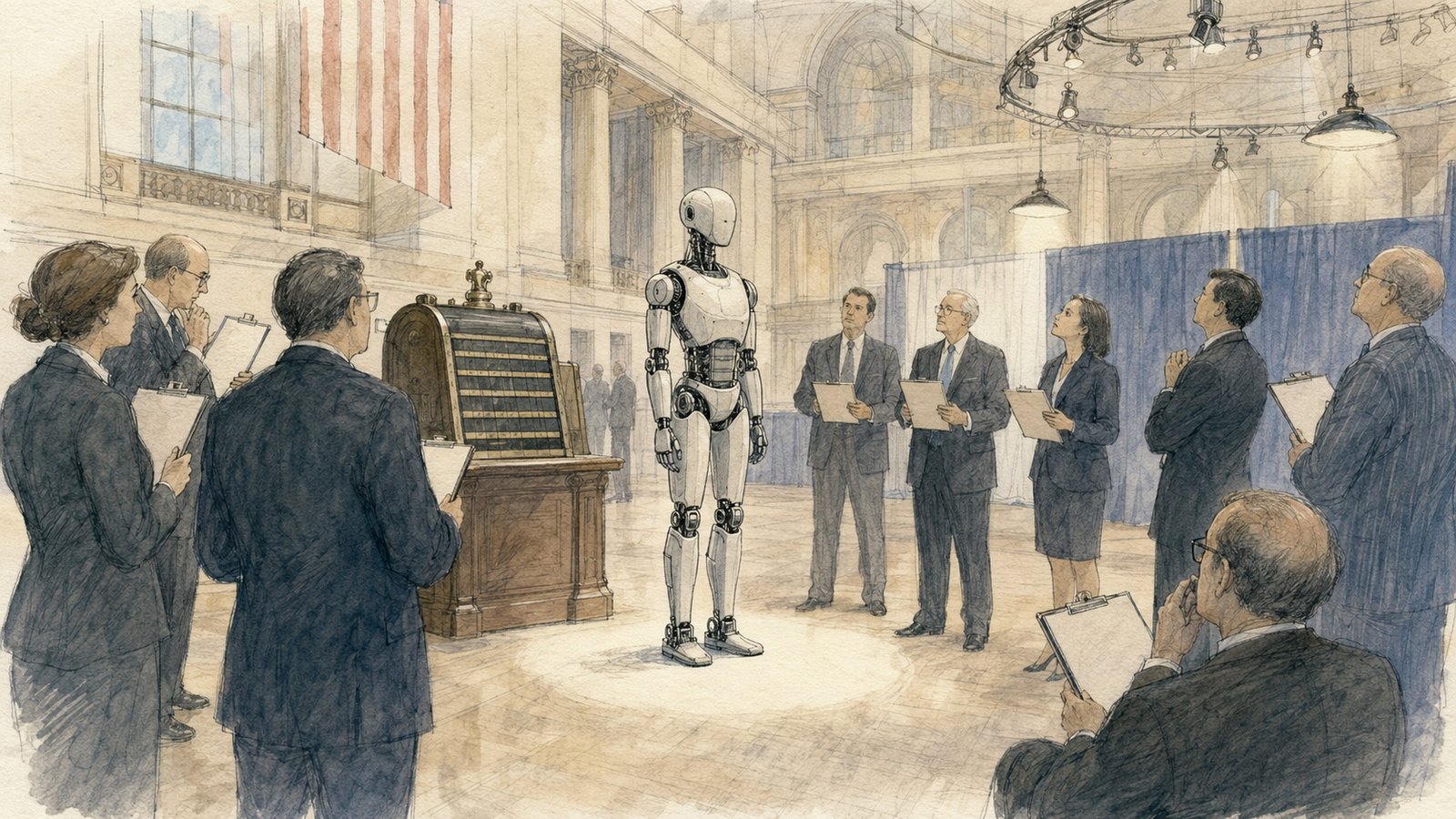
A humanoid robot standing in front of a New York Stock Exchange ticker board displaying financial data
Agility Robotics’ agreement to merge with Churchill Capital Corp. XI in a $2.5 billion SPAC deal is more than just a liquidity event. It is a structural inflection point for the entire physical AI sector. By stepping onto a public exchange, Agility is dragging the humanoid robotics industry out of the cozy, speculative realm of venture capital and into the unforgiving light of public markets.
The industry is officially graduating from "research-grade" prototypes to "public-market-grade" operations. And the transition is going to be brutal for companies that haven't prepared for it.
The End of the Demo Era
For the past decade, robotics startups have traded on the currency of the viral demo. Venture capitalists underwrote massive valuations based on the theoretical limits of what a machine could do in a carefully controlled lab environment, fluid backflips, perfectly orchestrated object manipulation, and highly edited interactions.
But Wall Street does not underwrite potential; it underwrites unit economics.
By becoming the first publicly traded, pure-play humanoid company, Agility is establishing a baseline that the rest of the industry will be measured against. The market is signaling that the era of raising hundreds of millions of dollars on the promise of "generalized artificial general intelligence in a humanoid form" is closing. Investors now demand to see the revenue-generating reality of physical machines doing dull, repetitive work.
The Forcing Function of Transparency
Going public introduces a ruthless forcing function: the SEC filing. The required S-4s and subsequent quarterly 10-Qs will strip away the marketing veneer that has blanketed the robotics sector. As a publicly traded entity, Agility can no longer rely on vaguely defined "strategic partnerships" or perpetual "pilot programs." They must answer to institutional analysts who demand hard, auditable operational metrics.
Because of this transparency, we are about to witness the industry's vocabulary shift overnight. The conversation on earnings calls will not center around degrees of freedom, bionic joint torque, or the nuances of foundation models. Instead, the survival of public robotics companies will hinge entirely on supply-chain KPIs:
- Cost-per-Pick: Does the amortized hardware and software cost of the robot actually undercut the hourly rate of human warehouse labor?
- Mean Time Between Failures (MTBF): How many shifts can the robot operate before a servo burns out, a fluidic line leaks, or a sensor degrades?
- System Uptime: Can the fleet maintain 99.9% availability, or do edge-case failures require constant human intervention and teleoperation resets?
Revenue Over Research
Agility's pitch to the public market is deliberately grounded, and that is its greatest strength. They are not promising a generalized robot butler for the consumer home, a milestone their own leadership admits is over a decade away. Instead, they are pointing to a highly specific, active commercial pipeline: over $300 million in committed multi-year orders and 65,000 hours of active deployment with customers like GXO, Schaeffler, Mercado Libre, and Toyota.
This is what "public-market-grade" robotics looks like. It is the realization that a slightly less dextrous robot actually moving heavy totes in a dusty logistics center is worth exponentially more than a hyper-advanced prototype that requires a team of PhDs to reboot it every 45 minutes.
The humanoid market is currently crowded with nearly $30 billion worth of private valuations, much of it resting on the promise of future capabilities. Agility's debut will serve as the sector's ultimate reality check, forcing competitors to prove their operational viability. The hype cycle is over; the era of the robotic P&L has arrived.
More From Robotics Weekly


Part of Issue 4: Who Owns the Stack, published July 6, 2026→