hardware
Physics Over Brute Force: The Liquid Metal Paradigm Shift in Actuation
A 3.5x force amplification using just 0.5–2 volts of current signals a physics-first future for soft robotics, where the real engineering lever isn't bigger motors but smarter materials.
By Maya Chen, Humanoid Robotics · July 6, 2026 · 7 min read
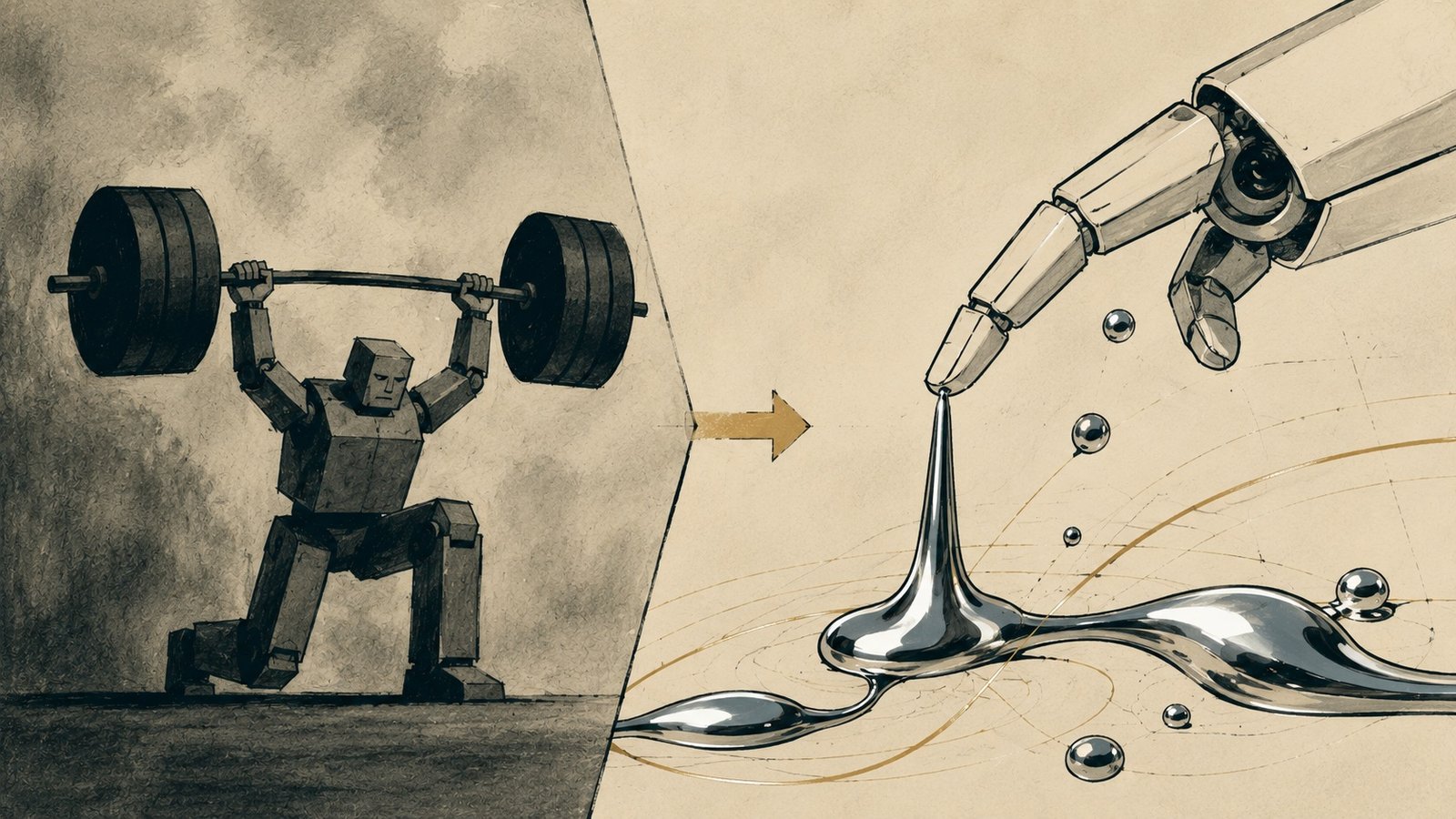
Microscopic view of a liquid metal droplet inside a soft robotic actuator, with current-flow indicators visualized
The recent breakthrough from the University of Bristol, an Electrocapillary-enhanced Magnetohydrodynamic Pump (EMP), is easy to miss if you only track the headline valuations of humanoid startups. But for anyone focused on the hardware interface layer, this development is a massive signal.
By applying a minimal electrical current (just 0.5 to 2 volts) to a liquid metal droplet, researchers amplified the output force of a fluidic soft robot by 3.5x. They achieved this without adding larger motors, compressors, or complex transmission systems. This is not just an incremental efficiency gain; it represents a fundamental pivot from mechanical brute-force scaling to first-principles physics.
The Limits of the Mechanical Wrapper
For decades, the standard approach to increasing a robot's power output has been fundamentally additive: if you need more force, you bolt on a larger servo, a heavier pneumatic compressor, or a thicker hydraulic line.
This creates a bloated, cascading architectural problem. Larger actuators require heavier chassis materials to support them, which in turn require even larger batteries to move the increased mass. The robot ends up fighting its own weight. In the realm of soft robotics, where the goal is organic, compliant interaction with fragile environments, this brute-force approach completely breaks down. You cannot build a responsive, localized system if it relies on a centralized, heavy compressor tethered by a web of pneumatic tubes.
Manipulating the Interface Layer
The Bristol EMP breakthrough proves that the solution lies in smarter physics, not larger hardware.
Instead of treating the actuator as a mechanical box that simply pushes fluid, the researchers manipulated the interface layer of the fluid itself. By introducing a liquid metal droplet (typically an alloy like Galinstan) into the channel and applying a tiny voltage, they exploited the electrocapillary effect to radically alter the droplet's surface tension. Combined with a magnetic field, this creates a highly efficient, localized pumping action with zero moving solid parts.
This is the hardware equivalent of moving from a bloated web wrapper to a highly optimized, native local application. It strips away the unnecessary mechanical abstractions, gears, valves, and pistons, and executes the required action directly at the physics layer.
Native Hardware for Native Intelligence
This paradigm shift in actuation is exactly what the next generation of robotics requires. As the industry moves toward highly integrated Vision-Language-Action (VLA) models and advanced architectures like the X1-D, the physical hardware must match the deterministic, low-latency execution of the software.
When a foundation model issues a micro-adjustment command to a robotic gripper, traditional geared motors introduce mechanical backlash and spool-up latency. Liquid metal actuators, entirely free of solid friction and mechanical inertia, can respond with the near-instantaneous latency required for true, closed-loop physical AI.
The most profound hardware innovations over the next decade will not look like traditional robotics. The future of industrial controllers and soft manipulation won't be defined by who can build the strongest motor, but by who can design the smartest interface, exploiting the fundamental physics of materials to do more with radically less.
More From Robotics Weekly




Part of Issue 4: Who Owns the Stack, published July 6, 2026→