labor-policy
The Societal Boundary: When the Robot Becomes the Teacher
San Diego's Altus Schools has deployed $500,000 worth of humanoid robots as classroom teachers and wellness coaches, forcing a reckoning with what happens when AI stops automating physical labor and starts simulating human care.
By Priya Raman, Labor & Ethics · June 29, 2026 · 11 min read
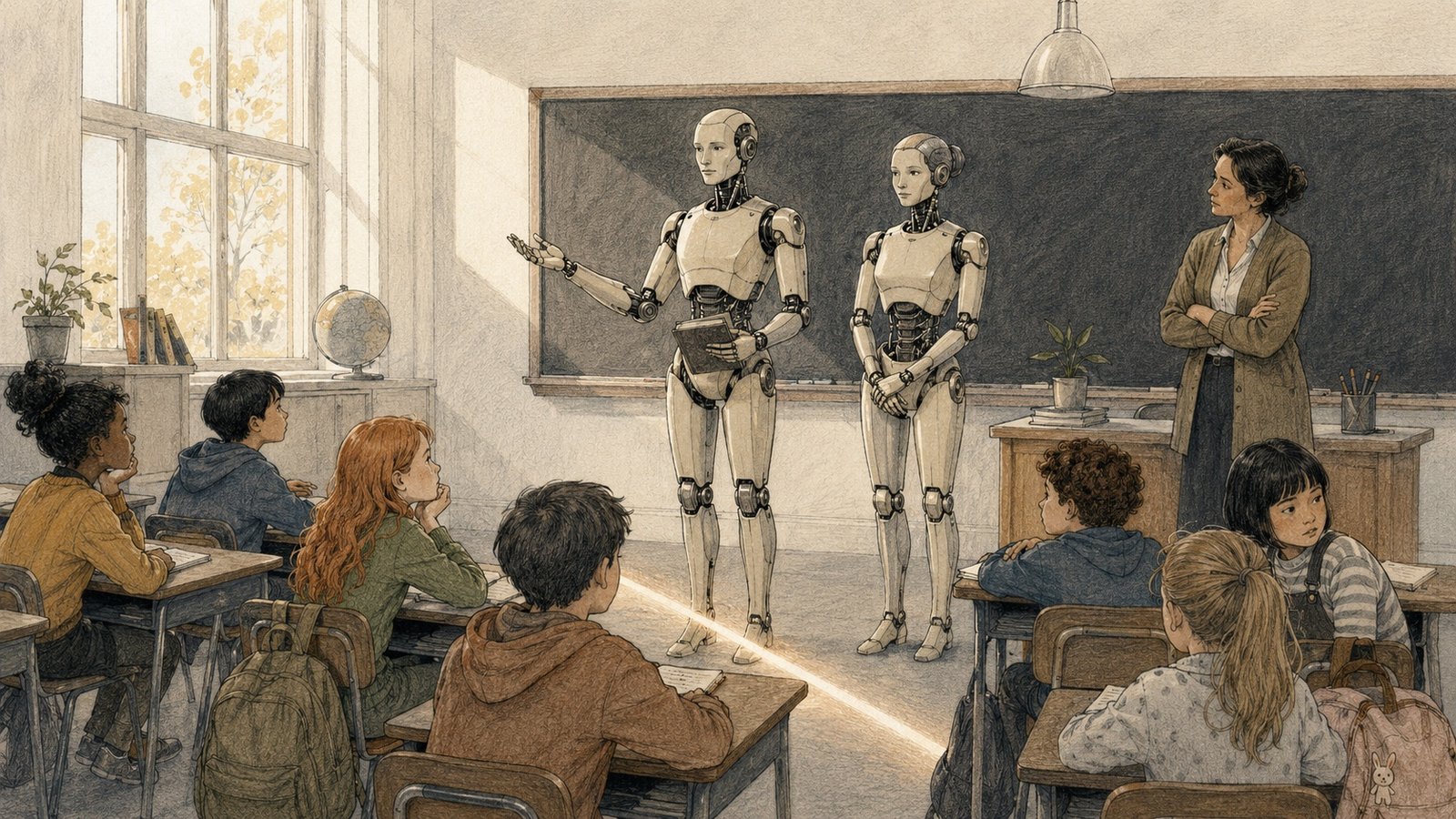
The Ameca humanoid robot with articulated facial expressions in front of a group of middle-school students in a classroom
A warehouse is a domain of physics. Success is measured in payload capacity, uptime, and the reduction of ergonomic injuries to human workers. The deployment of a humanoid robot in this environment, while financially complex, is ethically straightforward: it is a tool meant to automate physical drudgery.
But what happens when the humanoid leaves the loading dock and enters the classroom?
In late June, the theoretical debate over the social boundaries of embodied AI collided with reality. Altus Schools, a charter network in San Diego, confirmed the purchase of two "Ameca" humanoid robots, developed by UK-based Engineered Arts and powered by OpenAI's ChatGPT, for a staggering combined cost of $500,000. These machines, standing over six feet tall with highly articulated silicone faces capable of mimicking human emotion, have been deployed as part of an open-ended pilot program to act as "teaching partners" for middle and high school students.
This deployment forces us to confront a deeply uncomfortable frontier. We are no longer just automating physical tasks; we are attempting to automate human connection and mentorship. The Altus experiment is a flashpoint that exposes the raw friction between the tech industry’s relentless push for AI integration and the fragile psychological infrastructure of our public institutions.
The Cost of "Physical AI" vs. Traditional Pedagogy
The immediate and most visceral backlash to the San Diego deployment is financial. At $500,000 for two units, the capital expenditure is massive, particularly for a charter network serving a demographic that includes low-income students.
Proponents argue this is an investment in "physical AI." The hypothesis is that a student will engage more deeply with a physical entity that makes eye contact, blinks, and gestures than they will with a text box on a Chromebook. Altus has programmed the Ameca robots to embody four distinct personas: Sage the tutor, Ari the college planner, Lexi the translator, and, most controversially, Remi the wellness coach.
Critics, including leading educational researchers, point out the glaring lack of independent, peer-reviewed evidence proving that a $250,000 robot yields better academic outcomes than a $20/month ChatGPT Plus subscription. The educational value of the hardware, the motors, the silicone skin, the artificial eyes, remains entirely unproven. In a chronically underfunded education system, spending half a million dollars on experimental hardware while human teachers fight for basic classroom supplies feels to many like a dystopian misallocation of resources.
The Ethics of Manufactured Empathy
However, the financial debate masks a much deeper psychological concern. The most alarming aspect of the Altus deployment is the "Remi the wellness coach" persona.
Students who are struggling academically often face complex socio-emotional challenges. They require empathy, nuanced understanding, and the safety of a trusted adult relationship. Programming a machine to simulate that empathy, to furrow its silicone brow in feigned concern while a teenager discusses their anxiety, crosses a significant ethical line.
We are introducing vulnerable populations to a system designed to exploit human psychology. We are hardwired to anthropomorphize; when something looks at us and speaks, our brains register a social presence. But the robot does not care. It is running statistical probabilities to generate the most appropriate sequence of text, which is then translated into servo movements.
When a student forms an emotional attachment to a machine, a phenomenon already documented in early studies of social robotics, what happens when the pilot program ends and the robot is boxed up? What are the developmental consequences of training children to seek emotional validation from an entity that has no inner life?
The Labor Boundary: Augmentation or Replacement?
School officials are adamant that Ameca is a "teaching partner," not a replacement for human educators. This is the standard rhetorical defense deployed by every industry integrating AI. Yet, history tells us that capital seeks efficiency.
If a school district successfully normalizes the presence of an AI tutor, it is not difficult to envision a future where budget shortfalls are met not by hiring more teachers, but by increasing the student-to-robot ratio. The deployment in San Diego is not just a quirky tech experiment; it is the probing of a societal boundary. It forces us to define exactly which roles we believe require a human soul, and which can be outsourced to a sufficiently convincing algorithm.
The factory floor will inevitably be automated, and the economic arguments for doing so are sound. But the classroom is the infrastructure of human development. By inserting embodied AI into that space, we are risking far more than a wasted budget; we are experimenting on the nature of human connection itself.
More From Robotics Weekly


Part of Issue 3: The Accountability Gap, published June 29, 2026→