robotics-markets
The Billion-Dollar Assembly Line: Why the Future of AI is Local Hardware
Standard Bots' $1B valuation and a 70,000-square-foot New York factory show that the 'software brain, overseas body' model is reaching its limits, and owning your own assembly line is now a strategic moat.
By Daniel Osei, Financial Analysis · July 6, 2026 · 9 min read
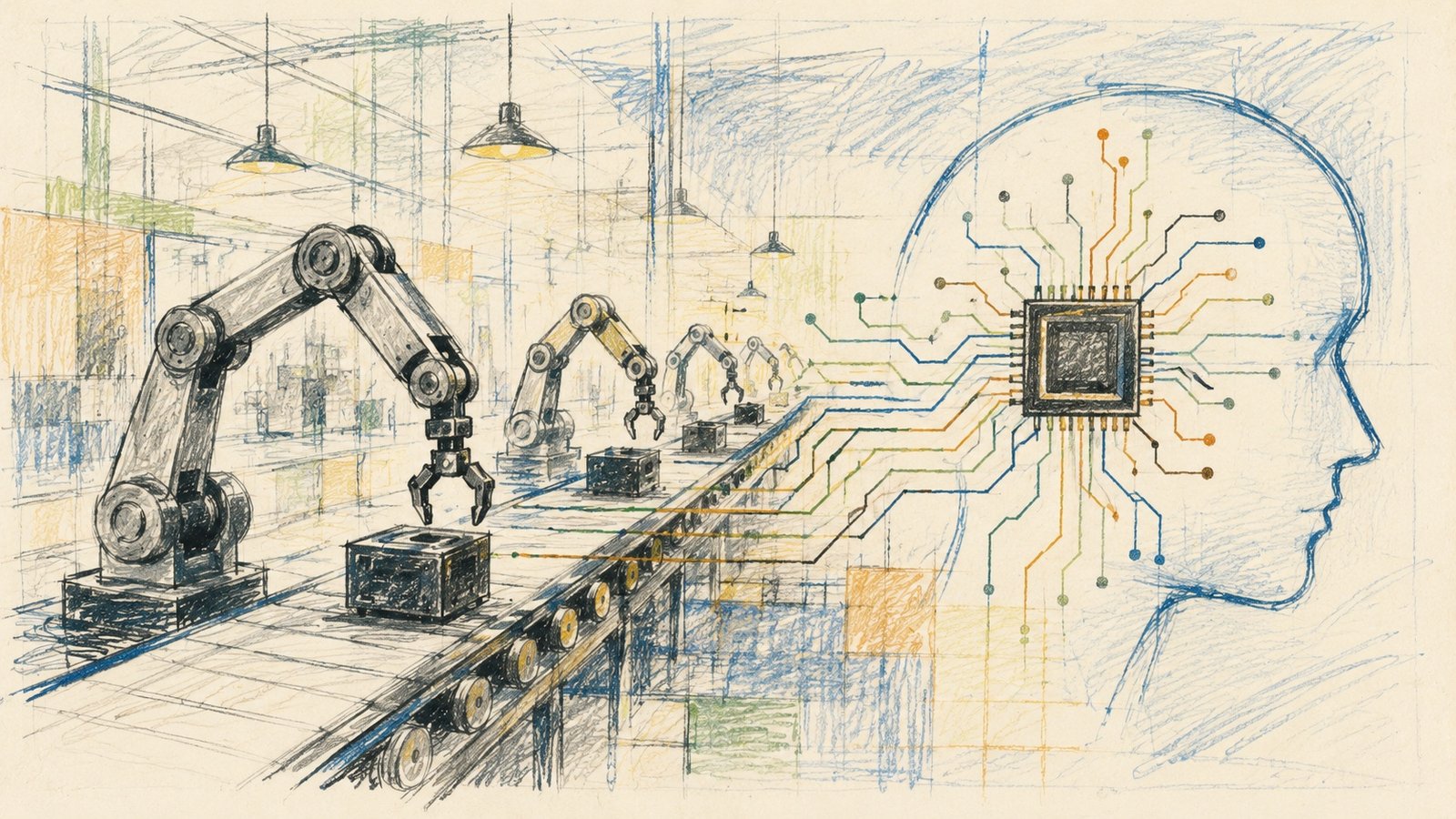
Inside a large US robot manufacturing facility with robotic arms assembling industrial robots on a production line
When Standard Bots closed its $200 million Series C last week, pushing its valuation to $1 billion, the most significant detail wasn't the cap table. It was the geographic footprint. At a time when the broader robotics industry is obsessing over cloud-based foundation models and software-first abstraction, Standard Bots is doing the exact opposite: they are aggressively expanding a 70,000-square-foot physical manufacturing facility in Glen Cove, New York.
Their mandate is simple but contrarian: "metal in to robots out," entirely within the United States. This $1 billion valuation is a massive market signal that the "software brain, overseas body" paradigm is reaching its limits. In the era of physical AI, owning the assembly line is no longer just a margin optimization, it is a critical strategic moat.
The Fragility of the Global Hardware Wrapper
For the past decade, the standard playbook for American technology companies has been to dominate the high-margin software layer while outsourcing the low-margin physical assembly to mature supply chains in Asia. This works perfectly for smartphones and laptops. But physical AI is not a smartphone.
When you are building AI-native robots designed to take over machining, welding, and palletizing on factory floors, the hardware is not just a passive shell. The actuators, the vision systems, and the joint telemetry are the literal inputs and outputs of the neural network. If your supply chain relies on shipping a generic bionic chassis across the Pacific Ocean, you are inheriting a massive, unmanageable risk.
Geopolitical tariffs, port strikes, and shipping bottlenecks mean that a company relying on globalized hardware can suddenly find its state-of-the-art AI effectively paralyzed, a brilliant brain trapped in a supply chain purgatory, waiting for its body to clear customs.
First-Principles Iteration Requires Proximity
Standard Bots' wager on local manufacturing goes deeper than avoiding supply chain shocks. It is fundamentally about the speed of engineering iteration.
True generalized automation requires tightly coupling the AI model with the physical hardware. You cannot effectively train an AI to adapt to the micro-frictions of a factory floor if the engineers writing the software have never touched the actuators executing the code.
By building their own actuators and assembling the final product in-house in New York, Standard Bots collapses the iteration loop. When the software team and the hardware team share a roof, a mechanical flaw discovered during a software simulation on Tuesday can result in a newly machined part on Wednesday. If that same part had to be redesigned, retooled, and shipped from an overseas contractor, the iteration cycle stretches from 24 hours to 12 weeks.
In a sector moving this fast, a 12-week hardware delay is a death sentence. Local-first manufacturing acts as a massive accelerant for software development.
Reshoring as a Competitive Advantage
The robotics industry is realizing that the ultimate wedge into legacy industrial markets isn't just having the smartest robot; it's having the most reliably deployable one. Standard Bots is on pace to capture 10% of U.S. industrial robot deployments by next year because they offer a predictability that overseas competitors cannot guarantee.
Their "teach by demonstration" no-code software makes the robots usable, but their domestic assembly line makes them accessible. They are proving that you don't need a generalized, walking humanoid to build a billion-dollar company. You just need an AI-native arm that works, built by a supply chain you actually control.
The market has made its bet: the winners of the robotics race won't just be the ones writing the best code. They will be the ones who remembered how to stamp the metal.
More From Robotics Weekly

Part of Issue 4: Who Owns the Stack, published July 6, 2026→